Back to Blogs
November 28, 2026
8 min read
Software development is evolving rapidly. Artificial Intelligence has introduced new ways to build applications, automate coding tasks, and turn ideas into working software. One of the biggest changes is the rise of vibe coding.
But does vibe coding make traditional programming less important? And what is the actual difference between these two approaches?
Let's explore how they work, their advantages, limitations, and when developers should use each approach.
Traditional coding is the process of developing software by writing and managing code using programming languages such as JavaScript, Python, PHP, Java, and C#.
Developers plan the application, design its structure, write code, debug errors, test functionality, and maintain the software.
This approach gives developers direct control over the codebase, application architecture, and development process.
Vibe coding is an AI-driven approach to software development where users describe what they want to build using natural language prompts, and AI tools generate or modify the code.
Instead of manually writing every line, developers communicate their requirements to AI coding assistants, review the results, and improve the application through repeated instructions.
For example, you can ask an AI assistant to create a responsive dashboard, add user authentication, or build a complete website based on your requirements.
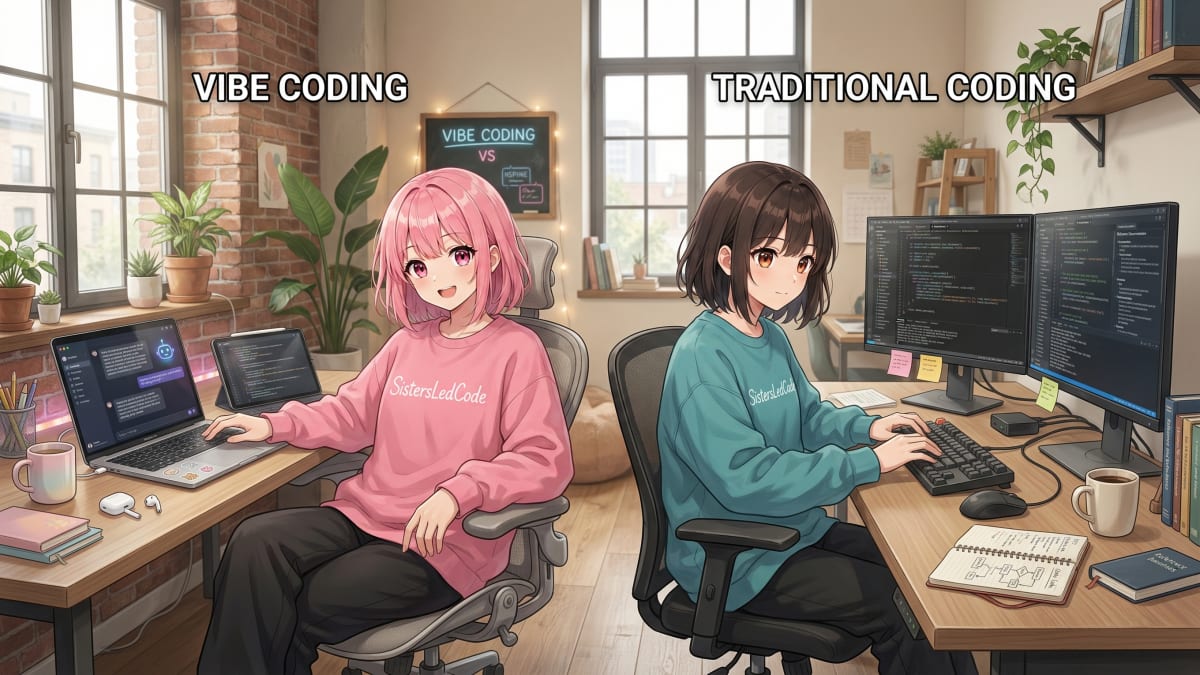
Both approaches aim to build functional software, but their workflows and level of human involvement are different.
| Feature | Traditional Coding | Vibe Coding |
|---|---|---|
| Code Creation | Mostly written manually | Generated with AI prompts |
| Development Process | Step-by-step programming | Prompt-based interaction |
| Developer Role | Writes and manages code | Guides and reviews AI output |
| Speed | Depends on project complexity and developer experience | Can speed up initial development |
| Code Control | Direct control over implementation | Requires reviewing AI-generated changes |
| Debugging | Manual debugging and development tools | AI-assisted debugging and testing |
| Technical Knowledge | Strong programming knowledge is important | Basic knowledge helps users understand and verify results |
Vibe coding does not remove the need for testing, code reviews, security checks, or technical knowledge. Developers should understand and verify important parts of their applications before deploying them.
Vibe coding is changing the way developers work, but it does not make traditional programming skills unnecessary.
AI can generate code, suggest solutions, and automate many development tasks. However, software still needs proper architecture, logical thinking, debugging, testing, and security.
Developers who understand programming fundamentals can use AI tools more effectively because they can identify mistakes, improve generated code, and make better technical decisions.
The best approach depends on the project and its requirements.
The future of software development is likely to involve a combination of human expertise and AI capabilities.
Developers will increasingly use AI tools to generate code, explore solutions, automate repetitive tasks, and improve productivity. At the same time, programming fundamentals, problem-solving, and engineering knowledge will remain valuable.
Rather than competing with AI, developers can learn to work alongside it and use these tools responsibly.
Vibe coding and traditional coding are not necessarily competing approaches. Both have their own strengths and limitations.
Traditional coding provides control and a deeper understanding of software, while vibe coding offers a faster and more conversational way to turn ideas into applications.
The smartest approach is to combine the speed of AI with the knowledge and judgment of a skilled developer.
At SistersLedCode, we believe that learning the fundamentals and embracing new technology go hand in hand. Learn, build, and grow with the future of software development.
Neither approach is always better. Vibe coding is useful for rapid experimentation, while traditional coding offers more direct control. The right choice depends on the project.
Yes. Beginners can use AI coding tools to experiment with simple projects. However, learning programming fundamentals is important for understanding and maintaining applications.
Yes. Developers can use AI-powered coding workflows to speed up development, generate code, explore ideas, and solve problems while reviewing the output.
AI is changing software development, but human skills such as problem-solving, architecture, critical thinking, and technical decision-making remain important.
Get in Touch